How to Read a Mountain Landscape Before a Day Walk
Mountain scenery can look immediately dramatic and strangely unreadable at the same time. From a roadside viewpoint or a valley floor, ridges overlap until it is difficult to tell which one is closer. A path that seems almost horizontal may climb steadily. A small patch of snow can sit much farther away than it appears.
Learning to read the landscape is part of the pleasure of a day walk. It does not require specialist geology or advanced navigation. It begins with a few simple questions: where does the water go, which lines are ridges, which are valleys, how does the light reveal slope, and what does the sky suggest about the next few hours?
Find the largest shapes first
Ignore individual rocks and trees for a moment. Look for the broadest forms: the main ridge, the deepest valley and the highest visible point. These large shapes organise everything else.
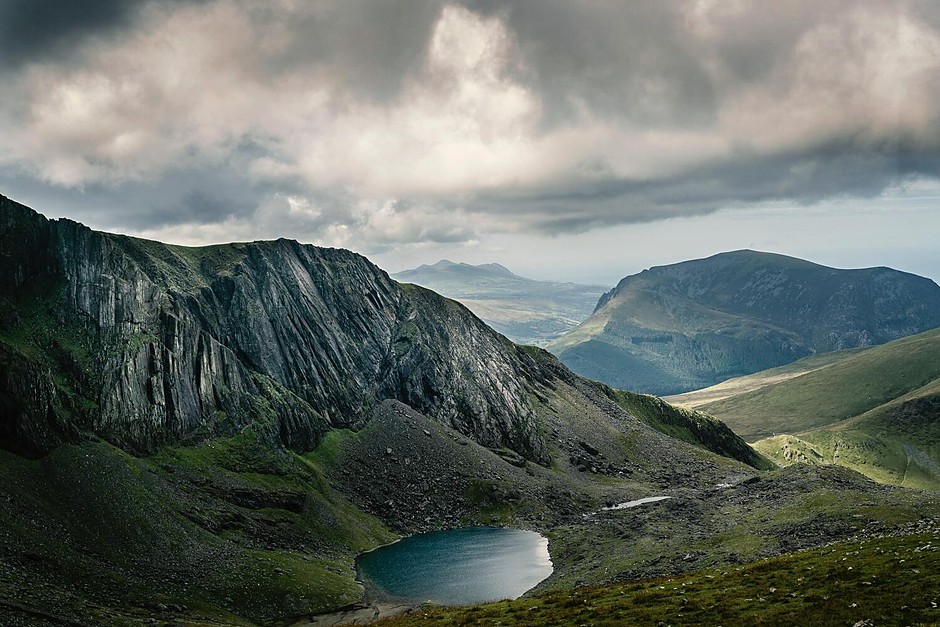
A ridge usually reads as a line that separates one slope from another. A valley draws the eye inward and downward, often toward a stream or river. When several ridges overlap, the nearer one tends to show more texture and contrast, while distant slopes appear softer and slightly paler.
This simple layering helps explain scale. What first looked like one mountain may actually be a sequence of foreground slope, middle ridge and distant summit.
Follow water downhill
Water is one of the easiest clues in a landscape. Streams gather in lower ground, so tracing them visually helps reveal the structure of a valley. Even when the water itself is hidden, greener vegetation or a line of trees can mark its course.
On a map, contour lines provide a more precise version of the same information, but the landscape already contains many of those clues. Once you start looking for drainage lines, shallow folds and steep gullies become easier to distinguish.
This also makes photographs more interesting. A stream, track or stone wall can provide a visual route through the frame, leading the eye from foreground into the hills.
Use light to understand slope
Cloudy mountain weather is often considered disappointing for photography, yet broken light can make topography much clearer. One slope catches sunlight while the next falls into shadow; a ridge suddenly separates from the mountain behind it.
When the sun is low, even small changes in angle become visible. Ridges cast long shadows, rock faces gain texture and grassy slopes show subtle folds. Around midday, the same scene may appear flatter because the light comes from above.
Watch the direction in which shadows move. They reveal not only the shape of the land but also how quickly conditions are changing. A bright patch can travel across a valley in minutes.
Scale is easier with a reference
Mountains distort distance because familiar objects are sparse. A path across a slope may look like a thin scratch until a walker appears on it. A building in the valley may be a full-size farm rather than a tiny hut.
Look for trees, fences, vehicles, people or buildings to give the view a sense of scale. Then compare those familiar objects with the distance to the next ridge. This can be surprisingly revealing.
The same principle is useful when choosing a route. A destination that looks “just over there” can involve a long descent and climb if a deep valley sits between you and it. The shape of the ground matters more than straight-line distance.
Read the weather as part of the scene
Mountain weather deserves respect because it can change quickly, but observation itself is also interesting. Notice where cloud is forming. Is it sitting on a summit, moving along a ridge, or rising from a valley? Are the clouds becoming thicker or breaking apart? Is distant visibility improving or fading?
For an actual walk, a current local forecast, a suitable map, appropriate clothing and route information are more reliable than visual guesswork alone. The point of watching the sky is not to replace those basics. It is to understand how weather interacts with the terrain in front of you.
A route can feel very different when cloud lowers over a high ridge or when sunlight opens a view into the next valley. Seeing those changes from a safe viewpoint is part of learning what mountain landscapes do over time.
Choose one line to follow with your eyes
Before moving on, choose a single feature and trace it from beginning to end. Follow a ridge from the valley to the summit. Track a footpath as it disappears behind a fold. Watch a dry-stone wall cross open ground and vanish into darker vegetation.
This habit turns a broad panorama into a collection of connected details. It also makes the view easier to remember. Instead of recalling only “big mountains,” you remember the curved ridge, the dark gully below it and the pale path crossing the slope.
A mountain landscape rewards this kind of patient looking because it contains several scales at once. There is the immediate foreground under your boots, the route across the hillside, and the distant geography stretching beyond it. Reading those layers does not make the scenery less mysterious. It makes the mystery more specific, which is often the beginning of wanting to walk farther.